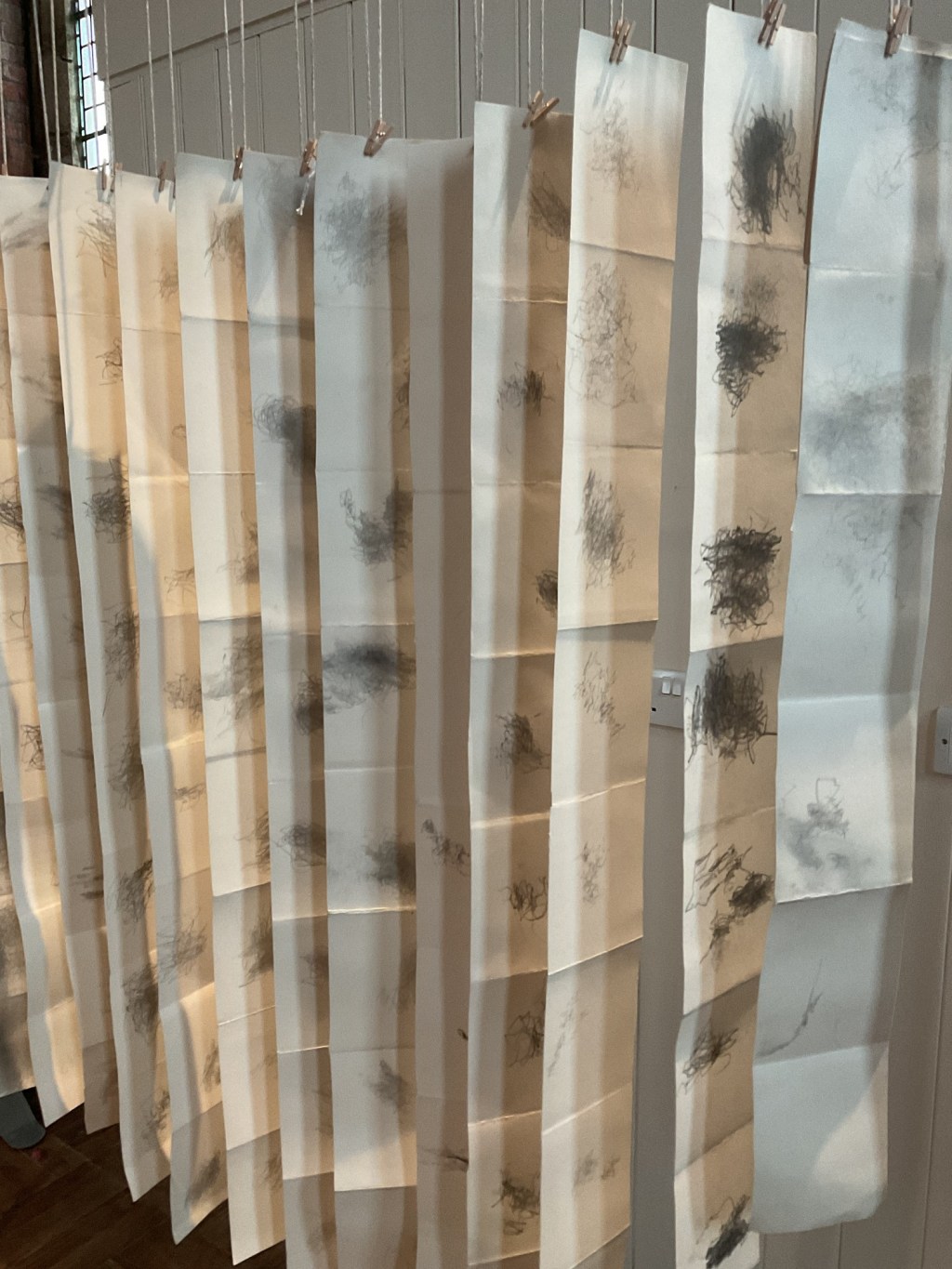
Pocket Drawings began as a simple experiment in walking and noticing. I drew inspiration from the artist William Anastasi. I became interested in what happens if drawing was guided not by the eye. Instead, it would be guided by the movement of the body itself.
On Lundy, where paths are shaped by granite, bog, tussocks, wind and weather, walking is never entirely smooth or predictable. Your body is constantly adjusting. It adjusts to the slope of the ground. It adjusts to the pull of the wind and the rhythm of your own steps. I wanted to find a way of recording that bodily negotiation with the landscape.
What is a Pocket Drawing?
A Pocket Drawing is made while walking, with a pencil and a small piece of paper tucked into a pocket. The pencil rests loosely against the paper. As the walker moves, the natural swing of the hip creates marks. The rhythm of their steps also contributes to the marks. There is no looking, no controlling the drawing, and no attempt to represent the landscape visually.
Instead, the drawing becomes a trace of movement — a record of balance, effort, hesitation, and flow. The body becomes the sensing instrument, and the landscape leaves its mark through motion rather than sight.
Walking with the Body, Not the Eye
Lundy is an ideal place for this kind of experiment. Steep climbs, uneven paths, muddy sections and exposed headlands all demand attention from the body. You feel the island through your feet, your legs, your breath.
During these walks, the mind is free to take in the sounds of seabirds. It enjoys the smell of salt and the shifting light. Meanwhile, the hand responds autonomously to the terrain beneath it. The drawing happens almost without thinking — shaped by elevation, texture, and rhythm rather than intention.
What appears on the paper afterwards is often surprising. There are dense clusters of marks where the ground was awkward. Longer sweeping lines appear where the path softened. Sudden changes are visible where footing became uncertain.
Inviting Visitors to Take Part
Visitors to Lundy were invited to take part in the project. They headed out on their own walks with drawing materials tucked into their pockets. Many people were unsure at first — slightly self-conscious, unsure what they were “supposed” to do.
But something shifted once walking began.
Comments from participants included:
“I felt quite embarrassed at first, but my daughter wasn’t — she loved it.”
“It made me much more aware of my own movements, especially the steps up and down.”
“I realised how much less fluid my body motion is than I imagined.”
“I really enjoyed recording each and every step down to North Light.”
The act of drawing without looking heightened awareness of the body in motion. People noticed how they moved, where they slowed down, where they felt unsteady or confident. The drawings became personal records of each journey — no two alike, even when paths overlapped.
Mapping Experience, Not Routes
These drawings are not maps in the conventional sense. They won’t tell you where to go or how to get there. Instead, they map experience.
They record how a place feels to move through. It includes the effort of a climb and the careful negotiation of boggy ground. They also capture the relief of firmer footing. In doing so, they offer a different way of knowing Lundy. This approach is rooted in the body rather than the view.
Seen together, the drawings form a quiet archive of embodied journeys across the island. Each mark holds a moment of contact between walker and landscape, shaped by weather, terrain, and time.
Letting the Island Lead
Pocket Drawings ask us to relinquish a little control. We should let the island lead and trust the body’s responses. They remind us that walking is not just a way of getting from one place to another. It is a conversation between ground and body. This occurs step by step.
On an island like Lundy, where the landscape is always present and always demanding, that conversation feels especially rich.


You must be logged in to post a comment.