On Lundy, we often experience a wild and windy landscape. A new film of Wuthering Heights is about to be released. The film will no doubt bring the windswept, wild Yorkshire moors back in the cultural imagination. A moorland that although several hundred miles away from Lundy, holds some similarities especially in the uncultivated and often windy terrain of the North End,
Wuthering Heights – The Film and Location
I have a planned holiday off the island at the end of February. I hope that I can get to see the new release of Wuthering Heights. The film stars Margot Robbie and Jacob Elordi. (Jacob Elordi was recently in Saltburn – a strange yet compelling watch).
As a northerner raised on the Lancashire/Yorkshire border. I’ve walked around Haworth, where the Bronte sisters lived. I have roamed the landscape that Emily Bronte wrote about. I know the feeling of those moors – bleak and beautiful. Seeing the trailer for the new film, I started thinking.
I began reflecting on how I experience a feeling of the Northern landscape when on Lundy. It’s not geographically close, but the atmosphere is similar. The feeling of being embodied by weather rather than sheltered from it. The sense that the land itself has a mood which you are walking in. Emily Bronte understood the power and romance of the moors. This inspiration led her to write a novel like Wuthering Heights.
You can watch the trailer for the film here…
Lundy and its similarity to the Yorkshire Moors
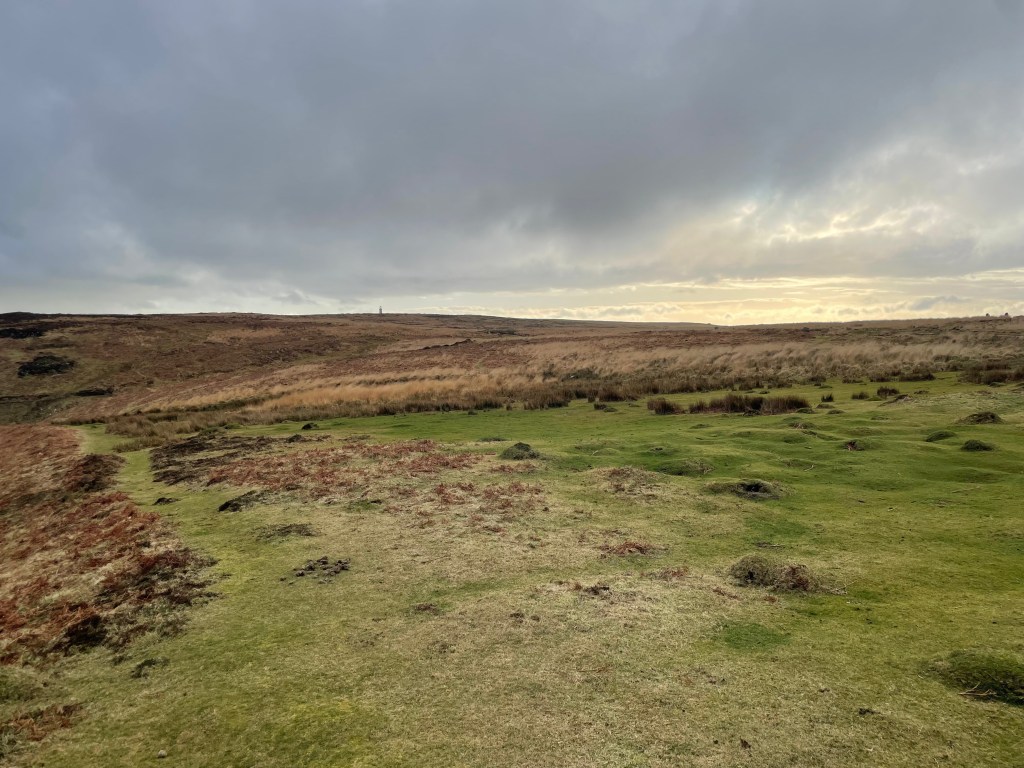
Lundy is not the Yorkshire moors, of course. It is a granite island, surround by water, shaped by Atlantic weather systems rather than Pennine winds. And yet, there are moments when the similarities are hard to ignore. This is particularly true at the North end of the island. The terrain here is more desolate, bogs and tussocks to be negotiated by stride. Heather underfoot, rocky outcrops breaking through the surface, no trees to interrupt the view. This is the part of Lundy that feels most like the North Yorkshire moors to me.
Heathcliff on Lundy
The Lundy landscape is dramatic and many find the location romantic. I recall being sat on a rocky outcrop one day last Autumn. I was sat at halfway wall. I caught sight of a tall, dark-haired, Celtic-looking figure striding across the heather towards me. For a brief moment — just long enough — I had my own Heathcliff moment!
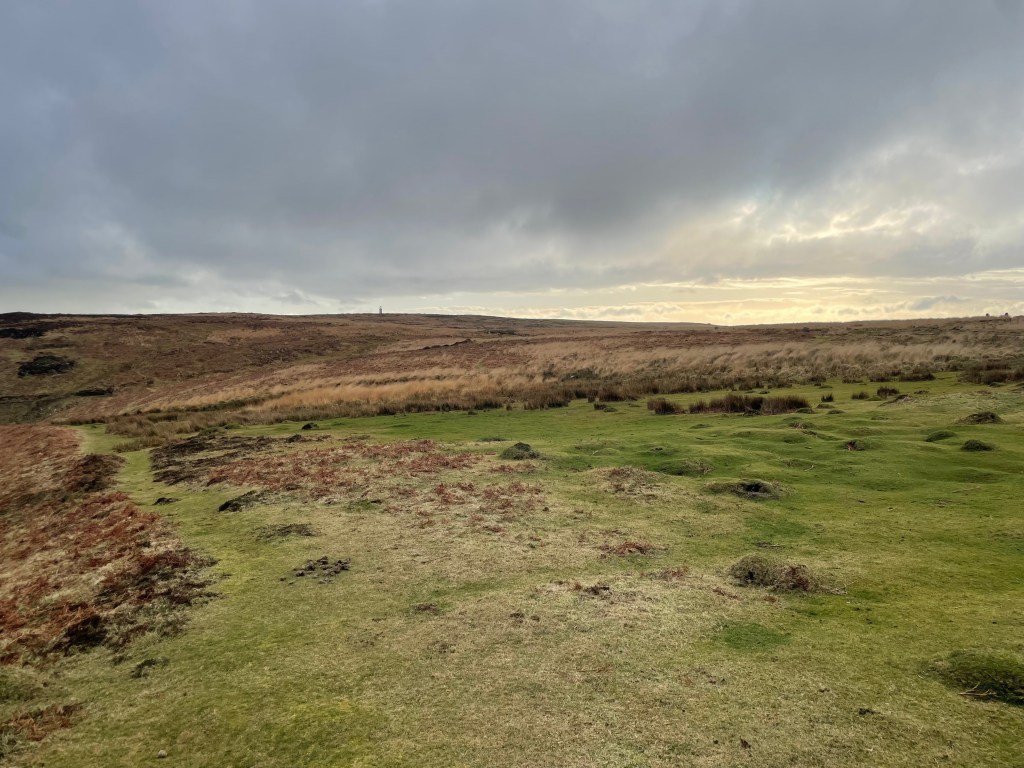
He turned out, not to be a brooding Gothic hero driven by passion and revenge. He was, instead, one of Lundy’s volunteer bird wardens! He was professionally focused on birds of the feathered variety rather than lost loves like Cathy. Had the Lundy landscape not been so desolate he have been any man taking a walk in the landscape. But in this location at that time and place he was Heathcliff to me.
If you are new to the Lundy Landscape, you can see a glimpse of it in this video. In the video I am looking for another Heathcliff, apologies for the wind noise, but this is Lundy after all!
With the film’s release, Kate Bush’s 1978 Wuthering Heights will no doubt surge up the single chart. It returns generation after generation. I must admit it. I have more than once channeled my own Kate Bush. Attempting to sing the dramatic haunting song whilst wandering in the landscape.
A class divide
There are Historic timelines that link Lundy and the Bronte family. Emily Bronte’s world was one where class, fate, land and identity were tightly bound. On Lundy, social structures have changed significantly. There was a time when class and landowners coexisted on Lundy.
There are architectural echoes to the book. The Villa (now Millcombe house) was built in 1836 by the Heaven family. You can almost imagine Miss Amelia Heaven who lived in the Villa from 1851 reading the Bronte sisters novels. There is no parsonage on Lundy. Although there is now accommodation attached to the church, which the Heaven family also built. These links to Bronte Country don’t go without notice.
Embodied Landscape
Walking on Lundy is not unlike walking on the moors in that way. Emotions surface more easily when you speak your own thoughts into the wind. There are no trees to soften the landscape, just moorland, sea, and sky.
That is why Wuthering Heights still resonates. It understands landscape and weather and how they can effect us emotionally. When I’m up on the heathland beyond Three-Quarter Wall, the wind pushes hard. The sea is just out of sight. It feels isolated, but it makes you feel alive.
Lundy doesn’t need Heathcliff and Cathy to be dramatic. It has its own stories, its own rhythms. Now and then, the moors of my northern childhood seem close. Easy to imagine that Emily Brontë would have understood this place instinctively.
Image credit
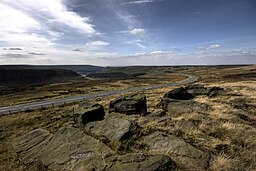
A view of Saddleworth Moor from Hollin Brown Knoll. Author Parrot of Doom
