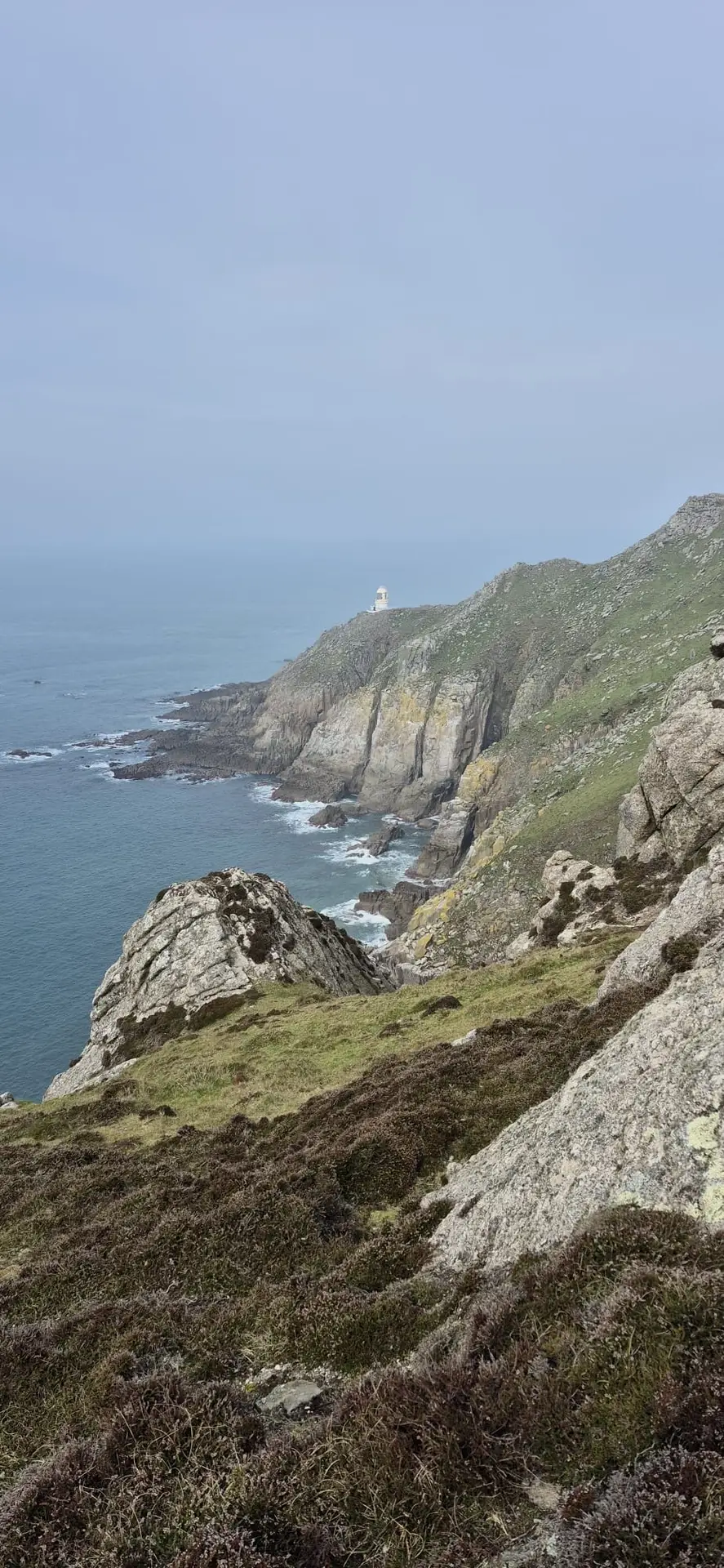
A walking journey across Lundy that reimagines “the North” through memory, landscape, and the shifting nature of place and identity.
Going up North
Today I went ‘up North’.
It’s funny how ‘going up North’ changes depending on where you live. Living on the mainland, ‘up North’ means home; Rawtenstall, Lancashire. I used to make this journey many times a year. Now, it’s a route that exists more in memory. Living on Lundy, going ‘up North’ is a walk to the of end the Island.
Where is North?
I’ve always thought of myself as a northerner. that shifts too. Someone will come into the Marisco Tavern and say they’re a northerner, but they come from Stoke! I will talk with someone from Cumbria, who would consider themselves more of a Northerner than me. Moreover a Scottish person would call us all southerners.
I feel that North isn’t fixed—it slides, depending on where you are. This is the topic of a book I am reading called; ‘The Idea of the North’.
My own ‘North’ is the industrial landscape of East Lancashire—Bury, Burnley, Bolton, Blackburn. Terraced houses, cotton mill towns, football grounds. The North that Simon Armitage writes about in his book ‘All points North’.
I hadn’t been up to the North End of Lundy for a while. It’s strange—when you’re a visitor, the North End feels essential. You have to go. But when you live here, it can become distant, almost optional. I know people who have lived on the island for years and have never made the trip!
During this visit up to the North, I walked with two fellow northerners. My brother Peter and his wife Judith accompanied me. Teresa, Lundy Head Chef, who once lived in Derby, joined us too. Is Derby considered the North? It was in the shared company that the comparisons began to surface.
Leaving the Village – The South
Leaving the village felt like leaving the South. The grass is more curated in the village and there are park benches. There is a shop that sells items, that in my mind, are quite southern and posh! These items do not fit my idea of ‘The North’. One can buy wildflower honey, Green & Black’s chocolate, Devon rum, and Pimms.

As you start along the path north, it becomes muddier underfoot. You start to feel the direction of the wind. You wonder what shape the journey will take. Will it be smooth, like travelling up North on a quiet Sunday morning? Or heavy going—stops and starts—navigating the landscape, like a Friday night drive to Manchester on the M6?
Quarter Wall: The Beginning of the Journey
We soon reached Quarter Wall, and it felt like the journey was truly beginning. Quarter Wall is one of several historic boundary walls. These walls cut across the island. They were originally built to manage livestock and divide land use.

By the time we reached it, this no longer felt like a short walk, but a journey. In my parallel universe, this marks the end of the North Devon Link Road. Leaving Devon and merging onto the M5 motorway. Where You start to see signs for larger places, marking distance and direction. Signs—North, South, East—constant orientation.
At Quarter wall, there’s only a single marker, which is at the East side wall. It is a date stone from the Lundy Granite company -half-hidden by brambles. We crossed on the West side – a stile – a gate but no signposts.
Beyond Quarter Wall, the path opens out. On the East side it becomes more linear, pulling you ahead. On the motorway, there would be signs for Taunton or Bridgewater. Here, there are only marker stones (for me paced out every 44 footsteps). Here the sense of distance stretches ahead.
On the West side the path cuts through the land—a quarried incision. It reminds me of the cuttings near Avonmouth, where the landscape is shaped and scarred by industry and travel. Even here on Lundy, the land holds that same tension between use and erosion.
Halfway Wall: The Midlands
Further along, the rhythm of the walk settles, and then breaks again at Halfway Wall.
Halfway Wall is the first real pause—a bottleneck. On the West side walkers can gather, waiting their turn to climb the stile. It felt like that familiar compression of traffic—the slow merging of the M5 onto the M6 motorway. A moment where movement is forced to stop and negotiate itself.
If you don’t want to navigate the stile, You can access the gate on the East section of the wall. This is like the toll road around Birmingham, a route that offers an open road for a cost. The cost in this case is navigating the ponies that often gather by halfway gate.

Crossing over the wall, it felt like we were properly heading north now. Not quite there yet, but committed. On the motorway, you measure this by distance markers or familiar landmarks. Here, it’s the walls themselves.

Three Quarter Wall: A Northern Threshold
By the time we reached Three Quarter Wall, habitation had almost disappeared. Tibbetts, one of the last buildings on the island’s northern stretch, is the final sign of shelter. After that, the island feels stripped back.

I thought of service stations—Keele or Sandbach—the places that marks a psychological threshold on a long drive north.
On Lundy there’s a quiet shift here—not just in landscape, but in mood. Conversation softens. You become more aware of your body, the effort of walking, the exposure. It feels like crossing into a place where there’s less to hold onto, physically and mentally.
Approaching the North
Further on, the path hardens underfoot. There is less grass, more stone. It feels tougher, more exposed—like the architecture of the North, solid and built to endure. The softness of the South gives way to something more weathered.
The sheep here are Soay—an ancient, small, and hardy breed often left to roam with minimal human intervention. On the northern moors, sheep are more actively managed, shaped by farming systems, yet still existing within a harsh landscape. There’s a shared resilience in both.
And yet, the idea of the North has changed. For many, it now exists as a place of consumption. It comprises retail parks, shopping trips, and places to pass time rather than move through. But Lundy’s North End offers none of that. No shops. No distractions. Even the mythical “North End Tandoori” remains just that—a myth.
It made me think about how landscape shapes posture, and posture shapes feeling. Whether it’s industry or weather, something external presses in, and the body answers.
I thought again of L. S. Lowry. His figures, bent over, carrying something unseen. On Lundy, when the wind picks up, people take on that same posture. They are not weighed down by industry or labour. Instead, they are bent by the sheer force of weather. The body responds in the same way.
Carrying the North With You
We reached the top.

We sat, ate sandwiches, and talked about hill walks around the industrial valleys, where we used to live. There was something about being there—with other northerners—that allowed those memories to surface more clearly.
I was wearing shorts, which made me chuckle. Growing up, you didn’t wear shorts ‘up North.’ You wouldn’t get the use out of them. The sun didn’t show up often enough to justify it.
And standing there, at the northern edge of an island in the Bristol Channel, I realised something.
North isn’t fixed.
It isn’t a point on a map, or a distance measured in miles. It is something constructed through memory—through journeys repeated, landscapes known, and the stories we attach to them.
Walking to the North End of Lundy didn’t replace my idea of the North. It sat alongside it.
- Distance: 5.5 miles
- Terrain: Boggy on the West Side
ps. I was reading a fellow blogger’s post who writes about the North west of Lancashire. He posted a photo of Pendle Hill, an infamous hill with stories of Witches. It is a hill I have seen many times and walked before. But my question is what do you see in the Photo? Look at the shape? Its uncanny!

Bibliography
Armitage, S., (2009). All Points North. Harlow, England: Penguin Books.
Davidson, P., (2004). The idea of North. London, England: Reaktion Books (Topographics).
Northwest Nature and History (no date). [Online]. Available at https://northwestnatureandhistory.co.uk/. [Accessed on 25/03/2026]