Visiting Lundy can be considered more of a pilgrimage than a journey. The Island draws people from far and wide, those that come by ship may have to endure rough waters to reach the island, but once on the island this ardeous advernture becomes a distant memory.
This pilgrimage concept finds suppport in Schafer’s words, as cited in Gablik (1991, p. 86) ‘you have to make your way, at some effort to a special place in order to have the experience’. Also Crater cited in Gablik, (1991 p 83) suggests that the difficulty in reaching a destination transforms a spectator into a participant.
Discovering Lundy becomes a personal journey, resonating with Kumar’s (2009) idea of finding a site that connects with our spirit—a place of solitude that reconnects us to the earth and as Gros (2023) suggests ‘a place where pavements no longer guide your step’
My continuing research will investigate how can we encourage participation to enhance the pilgrimage experience, transitioning from an observer to an active participant and whether this engagement could be fostered to enrich the Lundy experience.
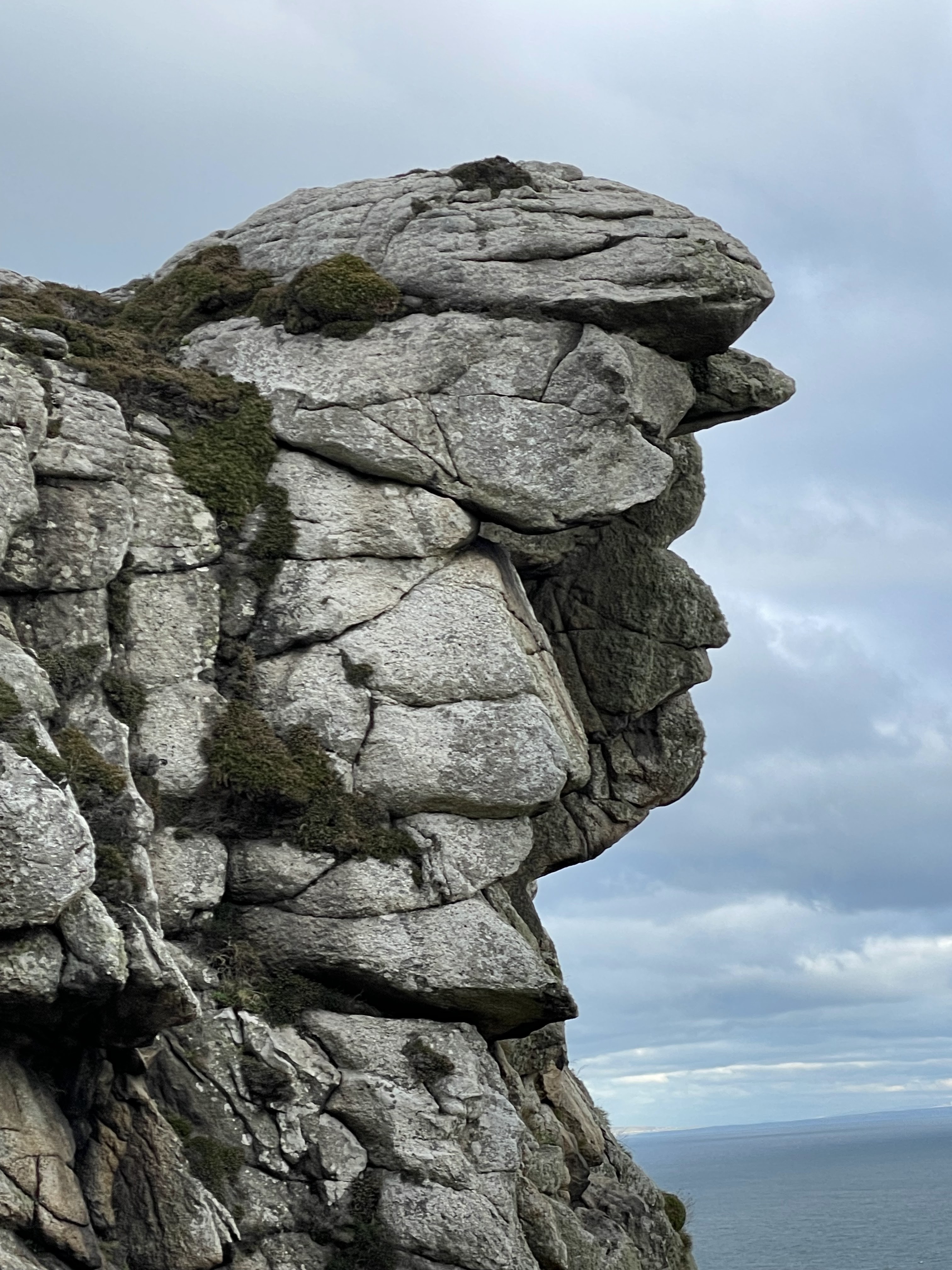
The Pilgrimage journey to Lundy starts back when the Knights Templar, are said to have owned Lundy in the twelfth and thirteenth centuries. The original role of the Knights Templar was to protect pilgrims on their way to Holy Sites. On the eastern side of Lundy, facing the rising sun, a rock formation in the shape of a head is known as Knight Templar Rock. This rock can be considered the Protector of the Lundy Pilgrimage.

Knight Templar Rock, Lundy
References
Bentley, J., and Paynter, N., (2011). Around a Thin Place: An Iona Pilgrimage Guide. Wild Goose Publications.
Gablik, S., (1991). The reenchantment of art. Thames and Hudson.
Gros, F., (2023). A Philosophy of Walking. Verso Books.
Kumar, S., (2009). Earth Pilgrim: Conversations with Satish Kumar. Green Books.
Bibliography
Hayward, G., and Mayhew-Smith, N., (2020). Britain’s Pilgrim Places: The first complete guide to every spiritual