This week, while looking back through old study notes, I came across notes from a lecture on working in isolation. Stephanie Owens gave the lecture at Arts University Plymouth. She responded to her experience as an art student at the beginning of the pandemic. This was a time when isolation became both enforced and strangely productive.
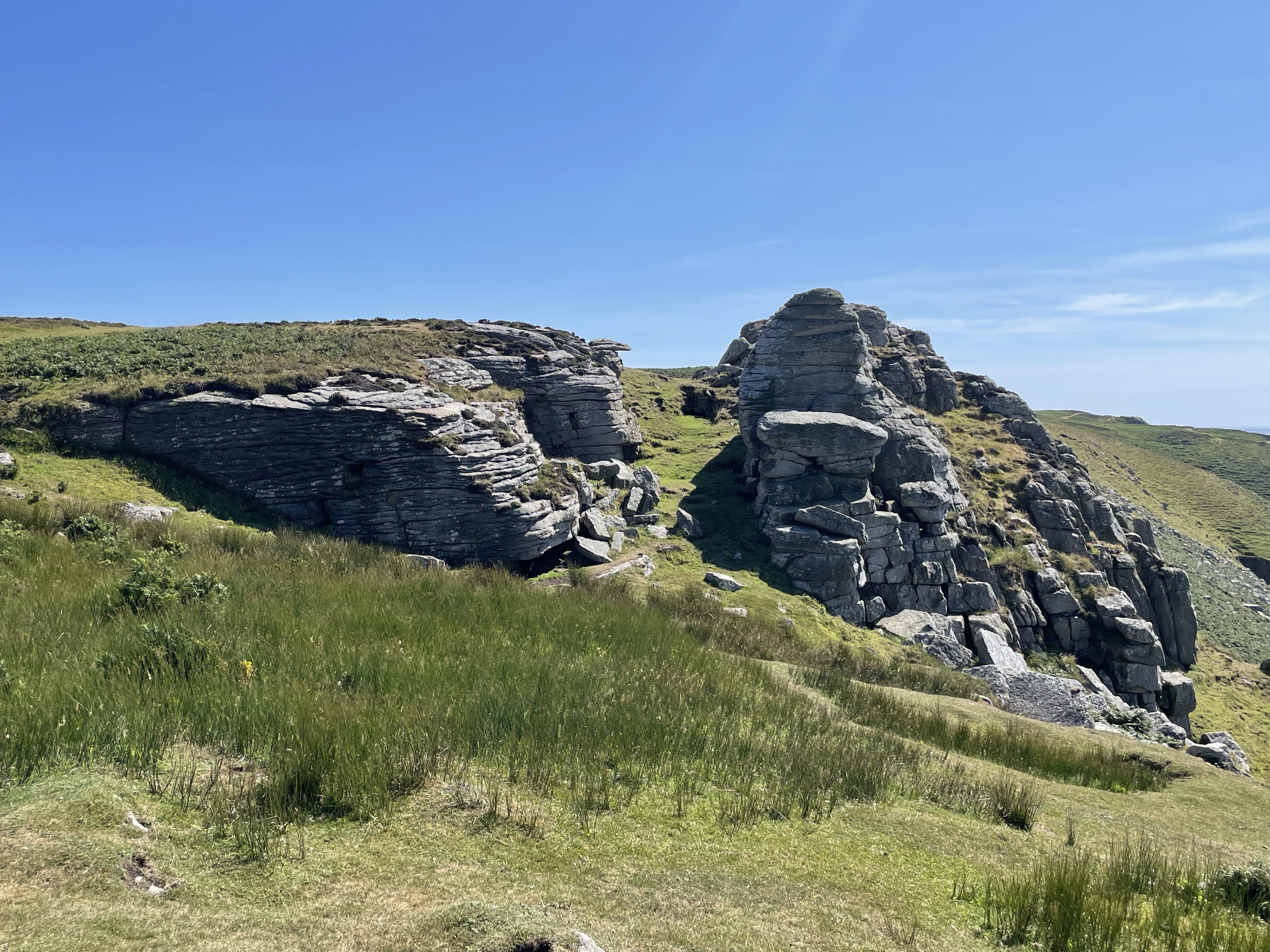
We were encouraged to look at artists attracted to empty landscapes. Where Sparsely inhabited landscapes drew their attention. Edward Hopper was one such example. When I first saw Cape Ann Granite (1928), I was struck instantly by how familiar it felt. The granite and the exposed land reminded me strongly of Lundy. It was reminiscent of one specific area just by Jenny’s Cove.

The painting is described by Hatfull (2020) as:
“Granite protrusions and windswept turf interlock in arrested poise, with claw-like shadows that reach towards fingers of stratus clouds, as if they might join hands.”
Hatfull, N. (2020). The Landscapes of Edward Hopper

Not long after revisiting that lecture, I went out walking on Lundy, heading towards the granite cliffs at Jenny’s Cove. I sat on the rock, away from distractions, and began to think about Hopper’s idea of the “empty landscape”.
But what does empty actually mean?
There are no cars here. No sirens, no human traffic, no building noise, no loud music. In that sense, the island feels stripped back. Yet from where I was sitting, this landscape was anything but empty.
Below the cliffs, there was a constant, layered soundscape. It included gulls, fulmars, puffins, guillemots, and razorbills. This is part of what the Landmark Trust describes as the largest single-island seabird colony in southern England. Above me on the plateau were wheatears and skylarks. A strong westerly wind gusted straight in from the Atlantic. It was loud and physical as it struck the side of my face.
This is not a quiet place. Nor is it empty of life.
Instead, it feels closer to what Robert Macfarlane describes. It is a landscape that has been “emptied rather than empty”. It is emptied of sustained human presence but alive with weather, movement, and non-human activity.
After reading Hermit (2023), I began to think about Lundy as a liminal space. A place between mainland and ocean, routine and retreat. Somewhere that allows for a temporary shedding of everyday roles. This sense of emptiness — or perceived emptiness — is exactly what draws people here.
During the pandemic, many of us experienced landscapes differently: quieter streets, reduced movement, an altered relationship with place. Returning to Lundy after that period, I wonder whether visitors are still seeking something similar — a stillness, a pause, an emptied landscape that allows space for thought, creativity, or simply attention
Reference:
Birdwatching (no date). [Online]. Available at https://www.landmarktrust.org.uk/lundyisland/discovering-lundy/activities/birdwatching/. [Accessed on 10/07/2023]
Hatfull, N., (2020). The landscapes of Edward Hopper. [Online]. Available at https://www.Apollo-magazine.com/Edward-hopper-foundation-beyeler-review/. [Accessed on 10/07/2023]
Fitton, J. A., (2023). Hermit: A Memoir of Finding Freedom in a Wild Place. Penguin Random House.
Macfarlane, R., (no date). Walking in unquiet landscapes – Tate Etc. [Online]. Available at https://www.tate.org.uk/tate-etc/issue-36-spring-2016/walking-unquiet-landscapes. [Accessed on 08/07/2023]