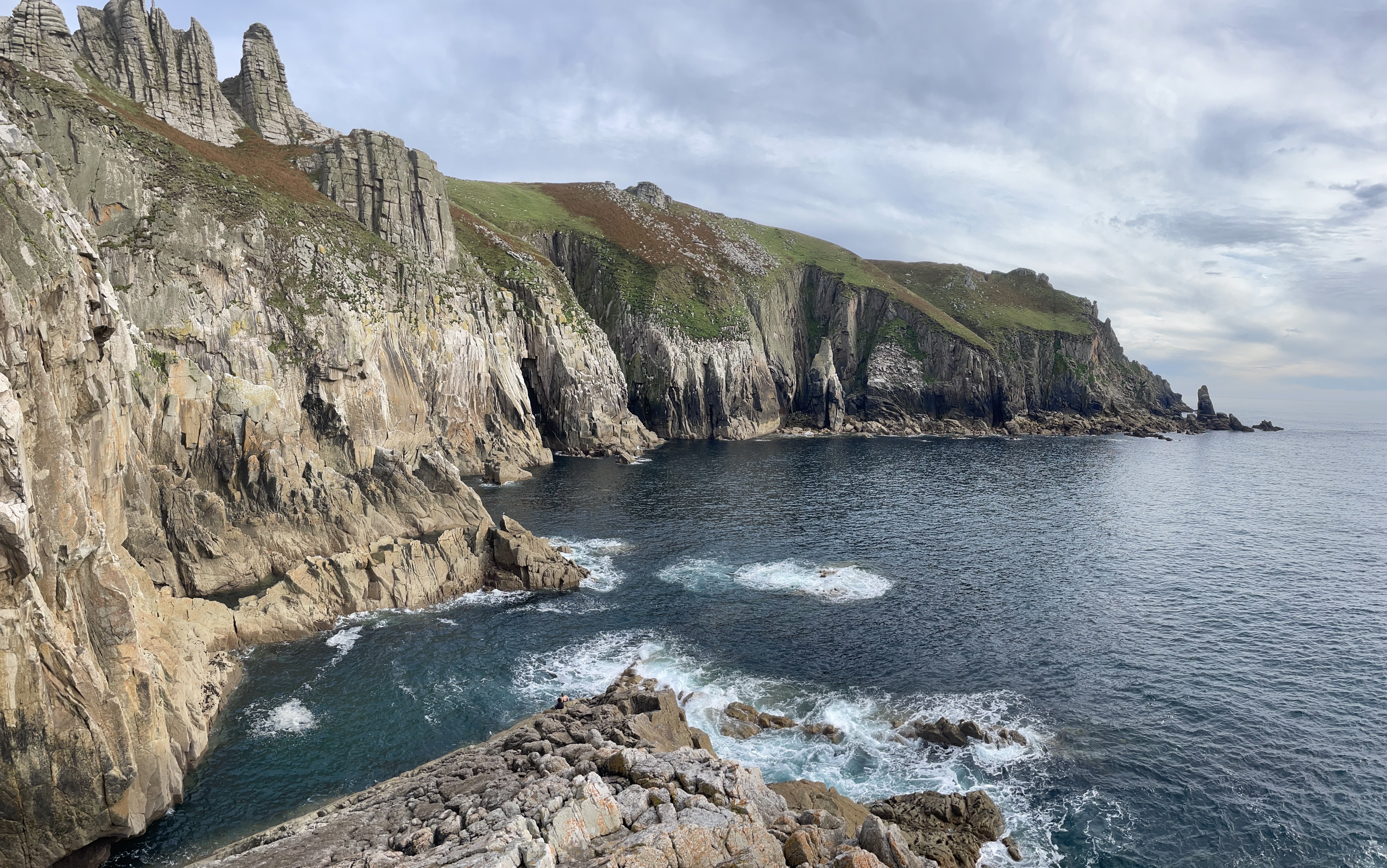
Jenny’s Cove is a well-known spot on Lundy. Still, most people only experience it from the top of the island on foot. My first trip to Jenny’s cove was on a dive boat. While waiting for divers, the boat gave the staff a chance to take a trip around the island. We traveled round from the South West of the Island. Seeing the rugged cliffs from the sea was sublime. Usually I am walking on the cliff edges, and only see from the top down.
The boat sailed into the large bay, which used to be named West Bay. In 1797, a ship ‘The Jenny’ sank in the cove. It carried a cargo of gold dust and ivory. It’s been called Jenny’s cove ever since. I wonder whether any of these treasures still lie at the bottom of the ocean.
As we reached the Cove, the boat sailed closer in towards the granite cliffs. As it did, I was awestruck. It was like entering a Cathedral. It was a huge cavernous space with rock structures like statues. The sound of the seabirds was phenomenal; Razorbills, Puffins, Guillimots, kittiwakes, Gulls, their cries echoing in the deep chasm.

Jamie (2013)writes about the Gannetry she observed in her book Sightlines.
‘each commanded its space, whether in the air or on the ledges where they made their fuss…. as some arrived, others were departing at speed, silent, heading straight out to sea….Whenever a bird landed, with its big wings flapping, all the neighbours raised a hue and cry, and that set off a chain reaction; so all over the cliffs there were outbreak of noise and aggression.
The next time I went to Jenny’s Cove, It was for a swim. The Easterly wind meant that swimming on the wilder Atlantic West coast is not possible. Nevertheless, this day was chosen due to the winds being Easterly. We carefully made our way down the side of the cliffs. You had to avoid the burrows. There was a fear of turning your ankle in the holes. These burrows are the home of a Manx Sheerwater or puffin in the breeding season. Maybe even a now more rare sight; a rabbit.
As the grassy bank turned to pure granite rock, I had to get down low and sometimes bottom shuffle. I knew they disembarked passengers in this part of the island. Strong Easterly winds sometimes made the landing beach inaccessible. There are still steps hewn into the rocks, where so called pilgrims have tred. But these steps disappear and from there you just need to find a way down through the narrow gullies.
We reached the bottom of the rocks where the land meets the sea. We found a safe place to enter the water. We knew this spot would also be our exit. Moving into the bay, swimming on your back and looking up 350m-500m high, I felt very small. Immersed in these edgelands where the rocks meet the sea, It was here that I felt totally embodied with nature. The seals came to investigate, not used to people swimming in these waters on the West side. The water was so clear. It smelt saltier and fresher on the skin. It was also crisper and slightly colder than the East side. Sometimes detritus can wash up there. There was no noise from people or human life just the sounds of nature.
References
Jamie, K., (2013). Sightlines. The Experiment.
Bibliography
Williams, M. A., (2011). The Lundy Companion: A Comprehensive Gazetteer of a Unique Island and Its Landmarks. Old Light Press.