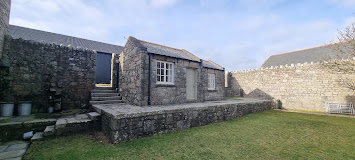
As I write this on 20th August, it’s National Radio Day, which seems the perfect opportunity to reflect on the role radio has played in my life and, more importantly, the vital role it has played in the history of Lundy.
Like many people of my generation, I have had Radio as a soundtrack through different periods of life. Growing up in Rawtenstall, a Northern mill town with three older brothers, I remember getting up in the mornings and switching off my parents’ choice of Radio 2 in favour of Radio 1. With four children, my parents must have found it a constant battle over the airwaves.

Later, as a student in the 1980s, I would listen to Radio Luxembourg, in bed at night. In the years that followed, I often listened to The Archers whilst driving home from my corporate jobs. Then CDs took over, and radio listening became less frequent for me, choosing to select my own playlist instead.
It is only since moving to a new house share, on Lundy, that radio has become a soundtrack of daily life again. In fact, the radio in our house launches itself into action at midnight each night, when all are sleeping. We think this is due to an alarm setting that my housemate activated, and we can’t work out how to switch it off! Or, an alternative story – being in a house with such history, could mean it’s a Poltergeist playing games on us – I like to think it’s the former!
Living on an island makes you think differently about communication. Although on the Island we now get mobile phone signal and internet connection (even if intermittent). In Lundy’s history, radio was not simply entertainment. It was a lifeline.
The Radio Room

Many regular visitors to Lundy know of the Radio Room, now a Landmark Trust property tucked away beside the Tavern. Just as an aside, did you know that, according to YouTuber Urban Tiger, it is the most affordable of all Landmark properties. I know from talking to Urban Tiger that he talks from experience, as he has stayed in a huge number of Landmarks in the UK. You can watch a tour of the Radio Room on his channel. The Radio Room still has a communications Radio in there, but I am guaranteed that this does not wake you up, like ours does, in the middle of the night.
A Noteworthy Event in 1930
What I did not realise, is that the Radio Room, wasn’t originally Lundy’s communications centre. The Lundy History Album records that the first radio equipment was installed in the Old Light in 1930. Curious to find out more, I turned to Felix Gade’s memoir, My Life on Lundy.
Gade writes, “the most noteworthy event of 1930 was the installation of the radio telephone at the Old Light.”
The Old Light location was chosen because of its elevation, which gave the best possible signal. Under an agreement with Trinity House and the Board of Trade, the island was expected to maintain a bad weather watch from the Old Light, during the night. However, nobody was employed to undertake this duty. Instead, Gade arranged for two daily radio calls to Hartland Point.

These calls became Lundy’s connection with the mainland. Through them, supplies could be ordered, messages exchanged and, most importantly, the well-being of the island confirmed.
Felix Gade’s Daily Walk
Reading Gade’s account, it is extraordinary to think about the effort involved in maintaining that connection. Each day he would walk from the village up to the Old Light to make his scheduled calls. In an age before mobile phones, email and instant messaging, this was the island’s primary link with the outside world.
During the Second World War, the Navy took over communications. Apparently they managed to break the existing radio equipment, but as a replacement system was installed, it proved beneficial for the island. Once the Admiralty signalling station had closed, responsibility returned to Gade. He was then required not only to maintain the regular communications schedule but also to report on shipping movements in the Bristol Channel. Some days this meant making as many as six trips to the Old Light.
Today, I think twice before walking to the Old Light once on a day off. It is a nice walk, but it is certainly not one that I would choose to make six times in a single day. Yet for Gade it was simply part of his working life, whatever the weather. Working on Lundy today, it is difficult to imagine the commitment required to keep an isolated island connected to the mainland.
Radio on Lundy Today
Eventually the radio equipment was moved from the Old Light to what became known as the Radio Room. Over the years the building has changed purpose several times, but now it remains the Radio Room and houses a working radio.
We now have an updated Radio Communications system in the office. When working in there, you often hear the opening exchanges of maritime communications. The Coastguard calls on Channel 16, asking a vessel to switch to another channel before continuing the conversation. We only hear the beginning, leaving the rest of the story to our imagination.
Modern technology means communication is far easier than it was in Felix Gade’s day, yet radio still has an important role to play in maritime safety around our coasts.
A Different Appreciation
National Radio Day has reminded me that radio is about much more than music, entertainment or nostalgia.
Less than a century ago, keeping in touch with the mainland depended on one man making repeated journeys to a windswept lighthouse, carrying out a task that most of us would now accomplish with a few taps on a phone.
Today, visitors may not give the Radio Room a second thought, walking past it on the way to the Tavern. Yet hidden within its walls is a reminder of a time when radio was Lundy’s lifeline, connecting this small island to the outside world.
Please comment if you have stayed in the Radio Room and whether you got the radio to work.
For more Lundy stories delivered to your inbox, I would love it if you would subscribe.