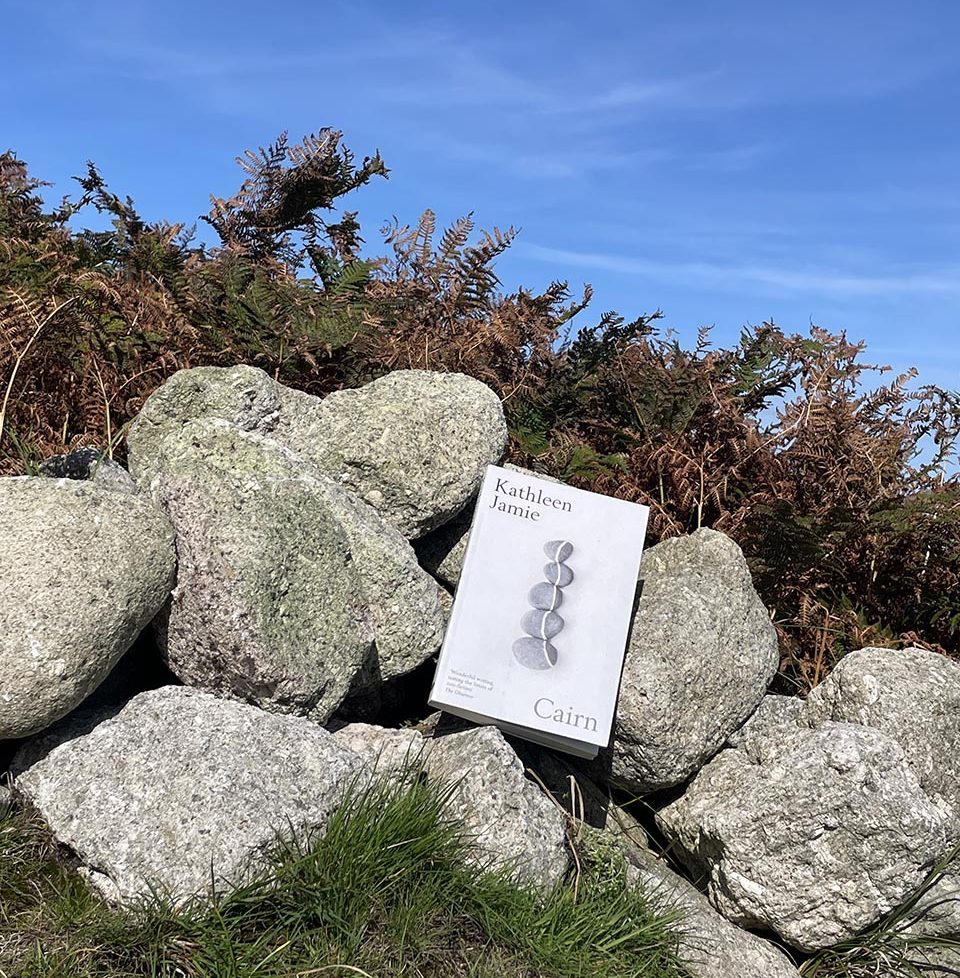
Kathleen Jamie describes a Cairn as a marker on open land, a memorial, a viewpoint shared by strangers.
Inspired by her book Cairn, I decided to investigate Lundy’s Cairns. I’ve previously written about the Standing Stones, so I wanted to learn about other stones and markers on the island. According to Historic England, Lundy has quite a few cairns, including several on Ackland Moor.
How hard are they to find? It’s a pile of stones, right?
What exactly is a cairn?
My understanding of cairns was fairly basic. I thought of them as piles of stones marking a route or perhaps indicating that you had reached the top of a mountain. Kirsty, the volunteer seal warden on the island, saw me reading Cairn in the Marisco Tavern, and we discussed cairns; she told me that Scottish Munros often have a cairn on top that climbers add rocks to.
On previous hikes, I’ve seen two Cairns. The top of Yr Wyddfa has a cairn with an interesting history; it seems part official and part unofficial. Then there is one on top of Dunkery Beacon, Somerset’s highest point, which has a professionally curated cairn marking the summit.
But are these the type of cairns I would encounter on Lundy?


I knew of one place that I thought a Cairn existed on Lundy, just at the top of the path down to Brazen Ward, but is this a recognised Cairn or just a pile of stones?
Searching for the Cairns, I walked out onto Ackland Moor. I vaguely recalled seeing a pile of stones whilst walking down the island’s west side. If my memory served me well, it was after the Battery, but before the Old Light, so I headed that way.
I couldn’t find what I had envisaged. I did find this lovely rocky mound that, from a different angle, might have seemed like a Cairn from a distance.

The best marker I had was the pond on Ackland Moor, shown on the Historic England map. So I climbed to the top, then headed south-west of the quarried pond.

The Lundy landscape wasn’t giving up its secrets quite so easily. There was nothing obvious. Old clumps of Gorse could easily hide a pile of stones. Eventually, I came across something just beside one of the fallen Standing Stones. Was this it?
It was a delightful spot. I clambered around the rocks, wondering whether this was really the sort of Cairn I had imagined. I decided to sit down. Then I noticed that the lovely rocky indentation where I was sitting held a little stonecrop garden.

It was a lovely spot to stop and take in the landscape. I’m still not entirely sure whether this was the Historic England cairn I had set out to find. I do remember that in May 2023, a microlight crashed not far from here!

Acland or Ackland
As I sat, I wondered about the Farmer who Ackland Moor was named after. The Moor is sometimes written as Acland Moor or sometimes Ackland Moor. Ackland, or Acland, was a farmer on Lundy, and his name lives on at Millcombe House, where one bedroom is named after him. He must have been quite an important part of Lundy.
Sitting here, I recall the other Millcombe bedroom names that run from A-G. The room names are quite an odd mix when you stop to think about it. Ships (Freckles/Devonia), a privateer (Benson), a landowner (Christie), a land agent (Gade), and a farmer (Ackland) all seem to have found their way into the house’s bedroom-name history.
Borrowed time
Lambs grazed on the Moor whilst I was there, enjoying the autumn weather. I found myself thinking about the extra time they had been given on the Island. The Beach Road repair has made it impossible to ship the lambs off to the mainland, so they have unexpectedly been given some extra time on the Island.
Perhaps they are making the most of it. Strangely, I feel that I am too. I was supposed to leave Lundy in the Spring. I planned to move on, find whatever came next and leave island life behind. Instead, I stayed for the season. It’s October, and I am still here. It feels like the lambs; I too am on borrowed time. Neither of us quite knows how long we have here! For now, we are still here.
Environmental impcat
When I started looking into cairns on Lundy, I hadn’t expected to think about the environmental questions surrounding them. We are much more aware now of the impact we can have on landscapes, even when an action like moving some stones seems harmless.
People worry about stones being moved from their natural positions, especially in sensitive landscapes. Stones can shelter and provide habitat for small creatures, while unofficial cairns can also confuse walkers if they mistake them for navigation markers.
In some places, people have even begun dismantling the stacks that visitors have created.
This made me look at the stones on Lundy differently.
A historic cairn that has become part of the landscape differs from a new pile of stones created simply because someone wants to leave their mark.
Perhaps the question is not simply whether we can move a stone. It is whether we should.
Being in the landscape
I think about this in my own creative practice too.
Much of my work is about connection to landscape: walking through it, noticing what is around me, collecting things washed ashore, making things from found materials, writing about places, and sometimes simply sitting still and paying attention.
That’s partly why I was drawn to looking for cairns. A cairn is made from the landscape, but it also changes how we see it. It can mark a route. It can mark an achievement. It can commemorate somebody. It can become a viewpoint. Or it can simply tell us that somebody else has been here.
And perhaps that is why I was so pleased to find this particular collection of stones, even if it wasn’t the Cairn I had been searching for. It gave me somewhere to sit, a view, and a little stonecrop garden that I hadn’t noticed until I stopped.
I still don’t know whether I found the Cairn Historic England recorded. But I did find something. I found a place to stop and look. I found lambs enjoying some unexpected extra time on the Moor. And I thought about my own borrowed time on Lundy.
Perhaps that is one of the things I like about cairns. They are markers, but they don’t necessarily tell us exactly what they mark. Someone might have been here. Someone has stopped. Maybe someone has added a stone.


Leave a Reply