Before moving to Lundy, I was drawn to the island’s edges. I was captivated by the cliffs and the quarries. These were the places where land gives way. During the Lundy Marine Festival with snorkeling and wild swimming that sense of edge shifted. It extended beyond the shoreline and into the sea itself.
What I discovered, quite simply, is that the festival opened something up in my practice. My creativity, which had been rooted in the landscape, began to include the seascape.
Snorkeling off the Jetty
Snorkeling became my way in. The first attempt was not graceful—I swallowed more seawater than I care to admit—but slowly I found a rhythm. I was firmly wetsuit-averse, yet I adjusted. With that adjustment came a new perspective. I looked up at jellyfish drifting above me. Their bodies caught the light. Seeing them from below felt like entering another world.
This experience has stayed with me and I find myself wanting to translate it into making. Perhaps, I could use yarn to echo the movement of kelp in woven pieces. I am also exploring whether seaweed itself could be worked into the process, either structurally or through natural dyeing. The sea is beginning to enter the work, not just as subject, but as material.

Jellyfish in the Quay
Jellyfish had a constant presence throughout the festival, particularly around the Jetty and Christie’s Quay. At first, I kept my distance. But, after a few inevitable stings, I became less cautious. I swam at the end of the jetty and encountered long trailing tentacles. The experience lingered for about twenty minutes. Antihistamines settled it. Even that felt like part of the learning: a bodily understanding of the water and its inhabitants.
Rock Pooling in Devils Kitchen
Rock pooling offered another way of looking. I only dipped into it briefly. It made me realise I want to return with more intention. Perhaps, on a guided ramble, to better understand what to look for and how to see. There’s potential here for a different kind of making too. This includes wall-based work that brings together crochet and weaving. Small marine forms are held within a larger surface.

Swimming on Lundy
Swimming became a shared experience as much as a solitary one. Most of it took place in the bay or from the jetty. One evening, a small group of us swam in Devil’s Kitchen. The tide was high, the moon was rising, and we were moving over submerged rock pools—territory usually hidden. It felt exploratory, almost like walking a landscape that had briefly become accessible.
There are limits, of course. I was invited to swim through the cave at Rat Island and decided against it—wisely, I think. The conditions need to be exact, with slack tide and calm seas. Even within this sense of openness, the sea sets its own terms.
Not all encounters were benign. Friends swimming at Devil’s Kitchen at low tide emerged quickly with rashes that later bruised—likely caused by snakelock anemones. Again, a reminder that this is a place of beauty, but also of complexity and care.

Untangled Exhibition
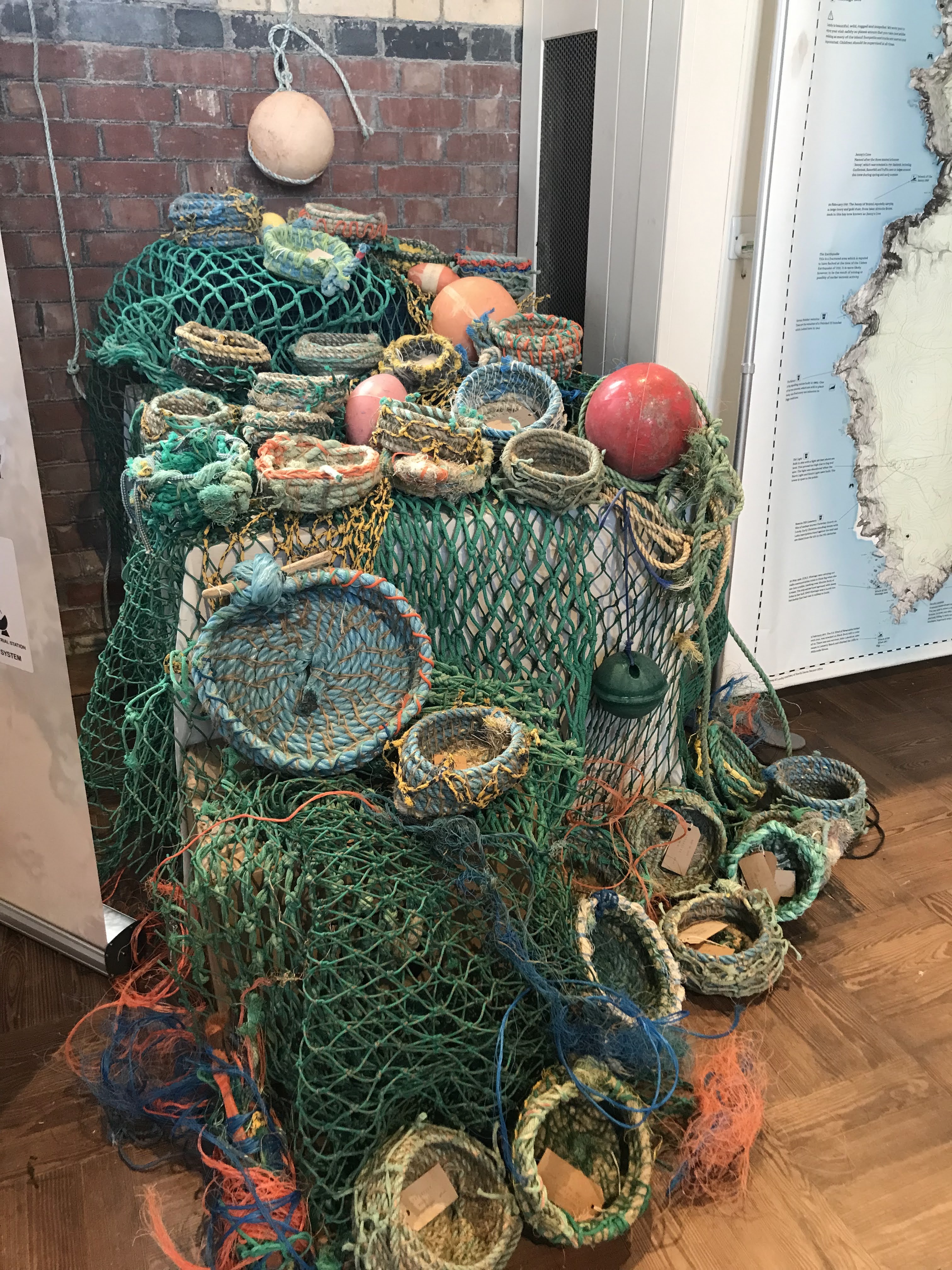
Alongside these experiences, I had the opportunity to show my ghost net baskets as part of the Untangled exhibition. Seeing the work gathered together like that felt significant. The pieces speak to the ongoing issue of discarded fishing gear—something that is not distant, but present here. Recently, a seal was spotted on Quarry Beach entangled in netting. It brings a sharp reality to the materials I’m working with and the stories they carry.

The festival may be over, but something has shifted. The boundary between land and sea in my practice feels more fluid now. I am no longer only walking the island. I am beginning to enter the water. I let the water shape the work in return.
If you would like to try snorkeling on Lundy. There are snorkeling safaris that you can book a place on.